Agentic AI Trading - A Case Study
- Coastline Private Advisors

- Jun 11
- 4 min read
Updated: Jun 18
A guide to the next generation of investing
While we encourage you to read through the full post to understand the nuances of our new Agentic AI service, we especially encourage you to spend time with the ‘So where do we go from here?’ section—we genuinely believe it captures the potential of what this service can become.

Hype or real, measurable results? This July, we’re excited to introduce our Agentic AI services. But beyond the excitement, an important question remains—does it deliver real value, or is it simply another wave of AI hype?
Interestingly, the past three days of trading have given us a timely and meaningful opportunity to put these capabilities to the test. It’s a chance to show how this new service can enhance your investment strategy in a practical, measurable way.
Let’s take a closer look and discuss where we go from here...
Market Volatility: From June 9 to 11, we had a unique opportunity to evaluate our new service and clearly quantify the potential gains for clients who were actively enrolled. Before diving into the results, a bit of context is helpful—three key events drove market movement during this period:
June 9 (Reuters): The S&P 500 and Nasdaq declined as an early rebound in technology stocks lost momentum, alongside rising geopolitical tensions after the U.S. signaled it would respond to Iran’s actions.
June 10 (Wall Street Journal): Ongoing conflict in the Middle East, coupled with concerns around inflationary pressures, continued to weigh on market sentiment.
June 11 (CNBC): Markets rebounded, led by strength in chip stocks, after signs of de-escalation emerged and progress toward a potential U.S.–Iran agreement was communicated.
This sequence of rapid market shifts created an ideal environment to assess how adaptive, intelligent strategies can respond in real time.

Our First, of many, AI Agents: Next, let’s take a closer look at how one of our AI agents operates in practice.
Our Asset Price Monitoring Agent is designed with a straightforward objective: continuously
monitor an asset’s price and automatically act when predefined thresholds are met—specifically, buying during price dips. While the concept is simple, it is grounded in a time-tested and effective strategy, especially when applied to high-quality, broad-market assets like the S&P 500.

In this example, the agent was configured to track VOO (Vanguard’s S&P 500 ETF). It periodically checks the market, and each time it detects a price decline of 0.5% or more, it automatically executes a $5 purchase. The client has opportunities to change limits.
Risk management and control are built in by design. All transactions are executed through a dedicated agentic brokerage account with predefined spending limits. In addition, safeguards are enforced through daily, monthly, and total investment caps, ensuring disciplined and controlled execution at all times.
As illustrated in the green box, on June 10, the agent identified two qualifying dips—0.91% and 0.70% relative to the prior day’s closing price—and executed two corresponding $5 purchases (configurable based on user preferences). In the yellow box, you can see that once the predefined limit was reached, the agent appropriately paused further buying activity, adhering strictly to its configured constraints.
This example highlights how a disciplined, automated approach can respond consistently and in real time—removing emotion while capitalizing on short-term market opportunities.
The Verdict?
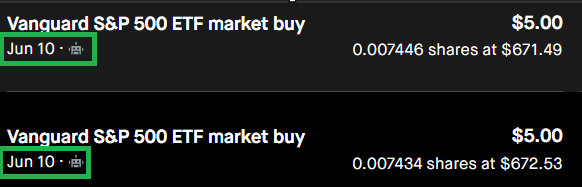
As of the June 11 market close, VOO reached $678.23. The purchases, pulled directly from the agentic brokerage account, highlighted in the green box—marked by the AI agent icon and corresponding timestamps—were executed at $671.49 and $672.53, resulting in an average gain of approximately 1% on each position.
While a 1% return may appear modest in isolation, it is important to view this in context. The agent’s behavior is fully customizable based on an investor’s risk tolerance and strategy. For example, it can be configured to act on larger price movements—such as dips greater than 1%—and to allocate higher investment amounts per transaction. Notably, between June 9 and June 10, the market declined by roughly 2.5%, presenting even larger opportunity windows under alternative configurations.
Additionally, over the past five years, the S&P 500 has delivered an average annual return of approximately 14%. In this case, the agent captured about a 1% gain in just one day, executing automatically.
So where do we go from here?
At launch, we offer a set of foundational workflows built on time-tested investment approaches—such as dip-buying quality assets and buy–hold–hedge strategies. Over time, we’ll continue to expand and evolve these capabilities, introducing more advanced strategies, including those driven by technical analysis, to further enhance outcomes.
A simple example is shown below, based on a manually executed day trade of SPCF—the ProShares Ultra SpaceX ETF, designed to deliver 2× the daily performance of SpaceX stock, enabling amplified exposure for short-term, bullish views. This particular trade resulted in a 10% upside.

Our goal is to have the AI agent take over this process—using technical analysis to automatically identify the optimal moments to enter and exit positions.
If you’re interested in this new service, we encourage you to review the FAQ section and connect with your principal advisor to learn more reach out to our Principal Advisor at mark.golez@coastlineprivateadvisors.com.



Comments